Showing posts with label SAIJIKI. Show all posts

9/11/2012

- AUSTRALIAN SAIJIKI -

[ . BACK to Worldkigo TOP . ]

:::::::::::::::::::::::::::::::::::::::::::::::::::::::::::::::::::::::::::::::::::::::::::::::::::::::::::::::


.................... AUSTRALIA SAIJIKI
A
ustralia Saijiki
:::::::::::::::::::::::::::::::::::::::::::::::::::::::::::::::::::::::::::::::::::::::::::::::::::::::::::::::
This saijiki is under construction.

Dear Haiku poets from the region,
please help with your positive support, info and contributions!

It is difficult to re-plant the Japanese kigo concept in areas that have different seasonal aspects and no "kigo culture".

A standard or rather many standards for seasons in Australia to be used for regional colletions of season words is still under construction. It depends on the Australian haiku poets and what they choose to write their poetry about.
Please contribute your aspects of existing season words or new season words you suggest for your area to help deepen the worldwide understanding of haiku poets for regional diversity.

It is a difficult undertaking, taking into consideration the various climate zones of the continent.

Apart from trying to find regional season words, we also suggest to collect and specify topics (keywords) for the areas where haiku poets have started writing Japanese-style short poetry.

Your input is most necessary and greatly appreciated!

Gabi Greve

WKD: Details about the many seasons of Australia
Study the basics here!


:::::::::::::::::::::::::::::::::::::::::::::::::::::::::::::::::::::::::::::::::::::::::::::::::::::


The Southern Cross
Click on the photo to see more haiku information from the area.

:::::::::::::::::::::::::::::::::::::::::::::::::::::::::::::::::::::::::::::::::::::::::::::::::::::


Adjustments for
Northern and Southern Hemisphere


If there is not specifical mention, a calendar reference kigo in the World Kigo Database refers to the Northern Hemisphere as its place of origin.
For the Southern Hemisphere, add six months.
December and short night are season words for summer in the Southern Hemisphere, for example.
SEE
Adjustments for the Southern Hemisphere


For a calendar reference season words originating in the Southern Hemisphere, add six months to get to its Northern counterpart.
These adjustments will not be mentioned specifically for each kigo in the database.

Calendar reference kigo
are for example the names of each month and then the many festivals of a specific date and the memorial days.
Japanese haiku poets up from the North of Hokkaido down to the South of Okinawa have no problem when using DECEMBER as a kigo, for example, since kigo are conventions for writing poetry.
Haiku poets from Australia are especially invited to contribute their aspects of moods and poetic allusions for each month in their area. What is your december like? Please let us know!


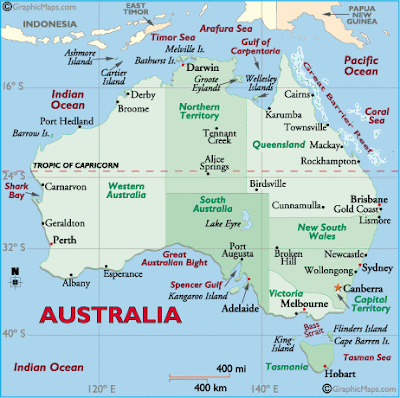
The East coast of Australia, near the Queensland / New South Wales border has the following seasons:

Spring -- September, October, November
Summer -- December, January, February
Autumn (Fall) -- March, April, May
Winter -- June, July, August


:::::::::::::::::::::::::::::::::::::::::::::::::::::::::::::::::::::::::::::::::::::::::::::::::::::

mid-north coast of New South Wales
It is a sub tropical area.
We do not experience seasons in the traditional sense. There is a quasi-summer starting at the end of September lasting till November. Summer properly starts then and can last till mid-March.
There is a short pre-Autumn for then till mid-April.
From then to the end of May it is clearly Autumn.
Winter varies a lot, but most years it will be June through to mid August.
True spring is very short here.

Flooding occurs anytime from September to the end of April and it defines the hot months. Flooding could be a season word for this period.
As well there is a native rush called Lomandra that has distinctive and beautifully perfumed blooms that grows by rivers. For many Australians living in this area, this is the scent of summer, so it could be a season word.
Jacaranda flowers are the most distinctive display of the late spring/early summer here and one of the ways people recognise the seasonal change.

Cassia and Tibochina flower at the same time during the pre-Autumn period and mark the season.
Paperpark trees also flower at this time, attracting lorikeets whose noisy carry on signals there arrival.
The outstanding feature of winter here is the dryness. It usually does not rain the whole winter. Grevillias flower in Winter.
Wattle arrives at the end of winter and is spring's herald.

Contributed by Violette Rose-Jones, March 2009


:::::::::::::::::::::::::::::::::::::::::::::::::::::::::::::::::::::::::::::::::::::::::::::::::::::


Summer in the northern parts of Australia, sub-tropical to tropical, Northern NSW to Queensland, NT etc are periods of much rain.
Northern Queensland and the upper NT [tropical] have two basic seasons,
the Dry [approx Autumn and Winter} and
the Wet [approx Spring and Summer.]
Lorin Ford, March 2009


:::::::::::::::::::::::::::::::::::::::::::::::::::::::::::::::::::::::::::::::::::::::::::::::::::::


© www.graphicmaps.com


:::::::::::::::::::::::::::::::::::::::::::::::::::::::::::::::::::::::::::::::::::::::::::::::::::::


If this rate of cultural cross-pollination keeps up, the haiku may replace the bush ballad as Australia's preferred mode of poetic expression.

By Jaya Savige
October 03, 2007

OF the broader developments in recent Australian poetry, one of the more prominent has been an increasing engagement with the cultures and poetic traditions of Asia. Open a contemporary collection at random and you're likely to find a haiku or a pantoum sitting alongside a sonnet or a set of quatrains. In terms of content, Bombay buses and Cambodian cyclos jostle with scooters in St Kilda and roo bars in the Pilbara.

In Martial Arts, the compact movements of the martial artist are conceived as "deadly haikus/an art as convincing as any classic". The term classic here connotes both Eastern and Western traditions, and suggests the extent to which the poet is working at the nexus of the two.

The versatile haiku form has been employed by many contemporary Australian poets, from Janice Bostok to Ross Clarke and Bronwyn Lea, but there has not been a more perfect marriage of Australian content and Japanese form than the first of Sydney poet Jane Gibian's Summer Sequence, taken from her new collection, Ardent:

stepping carefully
between pointed gumnut caps --
your bare feet


Eschewing all poetic trickery, the basic aim of the haiku is to capture a precise (seasonal) moment with pristine lucidity; the dynamism is provided by the kireji, or turn, which functions much like the volta in a conventional sonnet.

Read more HERE
© www.theaustralian.news.com.au


:::::::::::::::::::::::::::::::::::::::::::::::::::::::::::::::::::::::::::::::::::::::::::::::::::::

Season Words (kigo) for Australia and New Zealand


Spring:

Bogon Moth
Blue Triangle butterfly, bluebottle (Graphium sarpedon choredon)
burning cane

crocodile mating season
Crocodiles live in the North of Australia.
They might be considered a TOPIC in other parts.
. . . (dry season in other areas of the world)

dragon lizards

Fathers Day, September

Melbourne Cup, Horse race

picnic
Royal Melbourne Show
sandflies
shearing
snapper run (at Port Phillip Bay)
Snail
'ti-tree in bloom' (tea tree, ti-tree, tee tree)

Water dragon Physignathus lesueurii


wattle, national wattle day
wattle ( acacia family of plants)

ooo ooo ooo ooo ooo ooo ooo ooo ooo ooo ooo ooo


Summer:

Australia Day (26th January)
Anniversary Day, Foundation Day, ANA Day, Day of Mourning, Survival Day . . .

BeachWorldwide. Surfing.

Bees, bumble bees

Blackboy seeds (Xanthorrhoeaceae plants) Grasstree

Boronia - "Heaven Scent"

Boxing Day Australia, New Zealand, UK

Bushfire, wildfire


Christmas in Australia
Santa Claus

Cockatoo

cricket game

cyclone

December, January, February in Australia

floods (this might rather be a topic)


Frangipani, Plumeria
haze [not spring]
lightning [not autumn]
Long days (hinaga), long nights (nagaki yo)

mirage
moon jelly, jellyfish (kurage in Japan)

New Year and January

Peppermint tree (Agonis flexuosa)
Pelican
Paperbark tree, Melaleuca honey myrtles, punk tree

sunbathing
surfing
swimming

water clears, clear water
windmill[not spring]
Withered plants (by the heat)


......................... The New Year
is a season of its own in Japan, because we celebrate for almost two weeks with many special ceremonies and customs, according to the Asian lunar calendar.
In Australia, related season words could simply be classified for the summertime.

First Sun, First Sunrise, year's first dawn of the New Year


ooo ooo ooo ooo ooo ooo ooo ooo ooo ooo ooo ooo

Autumn:

Anzac Day (25th April)

Australian Football League season begins

blues festival (Byron Bay)

burnback (to prevent bushfires) also done in winter

cassia (yellow flowering shrub)
clear sky

Mother's Day

tailor (saltwater fish)


ooo ooo ooo ooo ooo ooo ooo ooo ooo ooo ooo ooo

Winter:

bottlebrush, Aesculus parviflora

Long days (hinaga), long nights (nagaki yo)


Matariki, Maori New Year and Pleiades
New Zealand


:::::::::::::::::::::::::::::::::::::::::::::::::::::::::::::::::::::::::::::::::::::::::::::::::::::


Non-seasonal Haiku Topics:
we might find a season for them as we go :


Aborigines

Airlie Beach, Great Barrier Reef

Ant, Bulldog ant (Myrmecia)

Black Forest, Adelaide


Boomerang

bulldust (ブルダスト) (fine red desert dust)


Cane Toad

drought
drought is a very real thing in Australia, it is not seasonal, certainly not in the sense of annually recurring seasons. For there to be a drought declared, at least one year of poor rainfall in an area must happen. Victoria is at present (March 2009)in its 11th year of drought (officially).

dust storm

Great Barrier Reef

Emu

Eucalyptus trees blue gum tree, Eucalyptus globus et var.

Fat Tailed Dunnart

Flannel Flower

Goanna / Monitor Lizard

Hakea plant

Hangi feast New Zealand, Maori

Ibis

Iguana


Kakadu (National Park)

Kingfisher - Kookaburra

Koala

Kanguru, Kangaru (Kangoroo)


Lorikeet, Australian lorikeets (Trichoglossus haematodus) Rainbow lorikeets


Magpie, Piping Roller (Gymnorhina tibicen)


Platypus , duckbill, duck-mole


Possum, fam. Diprodontia


Snakes, Red-bellied Black Snake

Rimu tree, giant rimu Dacrydium cupressinum

Skink, blue-tongued skink skink family (Scincidae)

Sturt's Desert Pea
with lovely red flowers

Tasmanian wilderness

Uluru (Ayers Rock)

Waratah flower

Whipbird (Psophodes olivaceus)

CLICK for more photos
Wollemi Pine (Wollemia nobilis)
This special pine belongs to the Araucariaceae family and has been around for 200 million years !
Wombat


Yam and Yam Dreaming Traumzeit, dreamtime

:::::::::::::::::::::::::::::::::::::::::::::::::::::::::::::::::::::::::::::::::::::::::::::::::::::

External LINKs, general information

Animals of Australia with photos

Animals of Australia, Marsupials and others


Australia PhotosAnimals, Plants and more


Australian Slang
G'day, mate! Koala Net


Haiku Category Earth
Australia's landmass of 7,617,930 square kilometres (2,941,300 sq mi) is on the Indo-Australian Plate. Surrounded by the Indian and Pacific oceans, it is separated from Asia by the Arafura and Timor seas. The world's smallest continent and sixth largest country by total area,[108] Australia—owing to its size and isolation—is often dubbed the 'island continent' and variably considered the world's largest island.
© More in the WIKIPEDIA !


The Nullarbor Plain is part of the area of flat, almost treeless, arid or semi-arid country of southern Australia, located on the Great Australian Bight coast with the Great Victoria Desert to its north. The word Nullarbor is derived from the Latin nullus, "no", and arbor, "tree".
© More in the WIKIPEDIA !


:::::::::::::::::::::::::::::::::::::::::::::::::::::::::::::::::::::::::::::::::::::::::::::::::::::
:::::::::::::::::::::::::::::::::::::::::::::::::::::::::::::::::::::::::::::::::::::::::::::::::::::


FIRST AUSTRALIAN HAIKU ANTHOLOGY Book Review

Wollumbin Haiku Workshop, John Bird 

Wollumbin Haiku Workshop, John Bird, 2006 


Haiku Dreaming Australia
seeks to enlist wide recognition that southern hemisphere kigo is not always understood or given its true value, even by those of us who live here. This, to date, has been inevitable.
After all, haiku originated from northern hemisphere Japan – and with the exception of a few southern hemisphere visionaries such as Janice Bostok in the 1970s– it found its most empathetic following in countries which experienced similar seasonal experiences and their related flora and fauna.
Haiku Dreaming Australia
Editor : John Bird


There will never be a 'collection of Australian kigo', an Australian saijiki to which Australian poets adhere. Even a collection of agreed season words is unlikely.

... Not kigo. I suggest national-symbolic keywords.

But these keywords can not be prescribed; their usage can not be enforced; only future generations can decide if their effectiveness persists. They must be allowed to evolve from the work of many poets over a long period. And they will, they will, if we write and share haiku about Australia.


Read the full article here:
Coming Clean on Kigo
John Bird, July 2007


(I do not share this view of John Bird, but it is an imortant aspect of the Australian search for its own haiku and season words culture.
Gabi Greve)

:::::::::::::::::::::::::::::::::::::::::::::::::::::::::::::::::::::::::::::::::::::::::::::::::::::


(under the Southern Cross)
by Gábor Terebess: Haiku in the Luggage


:::::::::::::::::::::::::::::::::::::::::::::::::::::::::::::::::::::::::::::::::::::::::::::::::::::

The Australian Haiku Society

In December, 2000, Australian haiku enthusiasts banded together to form HaikuOz

* to promote enjoyment of haiku within Australia,
* to bring Australian writers to the world haiku community.

The Australian Haiku Society would not have come into being without the tireless and thorough efforts of its founder and first contact officer and inaugural web manager, John Bird. Haiku Oz gratefully acknowledges its debt to his vision, passion and expertise in drawing Australian haijin together to create the online haiku community that it is today.

Patron: Janice M. Bostok
President: Beverley George
Vice-President: Lyn Reeves


http://www.haikuoz.org/about_haikuoz/

First Australian Haiku Anthology


 Spinifex: haiku
by Beverley George

ISBN 0 957843609 0
published by Pardalote Press


Between October, 2008 and March, 2009 HaikuOz published 74 responses by 71 poets (57 Australian) to the question, What is haiku?.
What is Haiku? - personal reflections
John Bird, April 2009


.................................................................................


HaikuOz: Haiku in Australia 2010

Haiku groups
As in Japan, small groups are at the heart and soul of Australian haiku writing. These are poems of observation, so it is fitting the groups are regionally based, allowing members to share urban or rural landscape.

These groups include Cloudcatchers (Northern NSW, led by Quendryth Young); Bindii Haiku Group (Adelaide, led by Lynette Arden); Mari Warabiny (Perth, led by Maureeen Sexton) Red Dragonflies (Sydney, led by Vanessa Proctor); Watersmeet (Hobart, led by Lyn Reeves) and Ozku (Sydney, led by Dawn Bruce.) The ‘paper wasp’ group (Brisbane led by Katherine Samuelowicz) is currently not meeting regularly but it is hoped that this will resume soon. It is not unusual for groups to go a little quiet and then reinvent themselves.
In Melbourne, Myron Lysenko conducts haiku walks ‘Ginko with Lysenko’ four times a year.

Beverley George

source : www.haikuoz.org/2010/09

.................................................................................


Australian Haiku BLOG
EMMA DALLOWAY


ooo ooo ooo ooo ooo ooo ooo ooo ooo


Eucalypt:
An Australian tanka journal appearing in May and in November each year.

ooo ooo ooo ooo ooo ooo ooo ooo ooo


Australian Haiku Poets and Authors
A growing LIST.


Watersmeet haiku group
Watersmeet is a group of people in Hobart who write and share haiku.
All Watersmeet members have had haiku published in a wide variety of print and on-line journals. Some have won prizes and commendations for their haiku and haiku-related works.


ROOKU

Rooku is an Australian variant of the short Japanese form called haiku, but without the usual rules. Rooku also lends itself to humour. Rooku has an Australian bent, and is more relaxed in structure.
It is a poetic snapshot of a moment in time.
Myron Lysenko
Rooku Troupe (Melbourne haiku poets Lia Hills, Matt Hetherington and Myron Lysenko) in conjunction with Connex Trains and The Committee for Melbourne.

Moving Galleries

:::::::::::::::::::::::::::::::::::::::::::::::::::::::::::::::::::::::::::::::::::::::::::::::::::::


where children play
the words of Mao
whitewashed

Read more here :
WATCHING PILGRIMS, WATCHING ME
An interview with Jodie Hawthorne


:::::::::::::::::::::::::::::::::::::::::::::::::::::::::::::::::::::::::::::::::::::::::::::::::::::

Hot Cross Haiku

Hot Cross Haiku serves tasty and thoughtful haiku by !an and authors from around the world. Baked daily in Melbourne, Australia, these haiku are best served warm and buttered.

http://hotcrosshaiku.blogspot.com/

:::::::::::::::::::::::::::::::::::::::::::::::::::::::::::::::::::::::::::::::::::::::::::::::::::::


Tasmania

CLICK for more photos

Tasmania is an Australian island and state of the same name. It is located 240 kilometres (150 mi) south of the eastern side of the continent, being separated from it by Bass Strait.
© More in the WIKIPEDIA !


Pardalote Press
Pardalote is committed to publishing poetry, especially poetry with a Tasmanian connection,

... publishes contemporary poetry, haiku and haiku related forms, and translations of ancient Chinese poetry with bilingual text..."
http://www.pardalote.com.au/


:::::::::::::::::::::::::::::::::::::::::::::::::::::::::::::::::::::::::::::::::::::::::::::::::::::


New Zealand

CLICK for more photos

New Zealand is an island country in the south-western Pacific Ocean comprising two main landmasses (the North Island and the South Island), and numerous smaller islands, most notably Stewart Island/Rakiura and the Chatham Islands.
© More in the WIKIPEDIA !


New Zealand Kigo - to use or not to use?
By Vanessa Proctor


New Zealand Haiku Magazines

Bravado:
published three times a year and may include haiku, along with poetry, short stories and articles.
Submit: Poetry Editor Tim Upperton

Kiwihaiku:
Is published bi-monthly in the NZ Poetry Society newsletter. Haiku submitted should have a distinct New Zealand flavour.
Submit: Editor Barbara Strang

Kokako:
published twice a year, and includes haiku, senryu, tanka, renga and related forms.
Editors: Owen Bullock, Patricia Prime


Valley MicroPress:

published 10 times a year.
Submit: Editor Tony Chad

New Zealand Poetry Society.
More is here.


Glossary of New Zealand Terms


Another Glossary for The Haiku Foundation, April 2012
Per Diem feature

Cabbage tree: Cordyline australis
Magpie: The Australian magpie (Cracticus tibicen)
Pohutukawa: Metrosideros excelsa flower
Tui: Prosthemadera novaeseelandiae, bird
Wax-eye: Zosterops lateralis, bird
and many more
Glossary of New Zealand Terms


:::::::::::::::::::::::::::::::::::::::::::::::::::::::::::::::::::::::::::::::::::::::::::::::::::

Welcome to the showcase of haiku by some of the best writers in New Zealand.

wedding day
the pear tree
sheds petals


- Barbara Strang


admires the new handbag
on the window sill
then Rangitoto's Fuji


- Bernard Gadd

with an index of all poets
. © HAIKU NZ SHOWCASE

:::::::::::::::::::::::::::::::::::::::::::::::::::::::::::::::::::::::::::::::::::::::::::::::::::::

Jeanette Stace (1917 – 2006)

low tide
I walk to you
across the sky


On 2nd October Jeanette Stace died peacefully. She was one of New Zealand's leading haiku poets and made a contribution to English language haiku, not only through her own poetry, but also by encouraging others to write and enjoy haiku.

She received many awards for her work, but was always modest about her achievements. Jeanette was an invaluable member of the New Zealand Poetry Society committee for many years.

:::::::::::::::::::::::::::::::::::::::::::::::::::::::::::::::::::::::::::::::::::::::::::::::::::


Topics from NZ

Christchurch Cathedral


:::::::::::::::::::::::::::::::::::::::::::::::::::::::::::::::::::::::::::::::::::::::::::::::::::::


[ . BACK to WORLDKIGO . TOP . ]
:::::::::::::::::::::::::::::::::::::::::::::::::::::::::::::::::::::::::::::::::::::::::::::::::::::

8/15/2012

Astronomical Saijiki

[ . BACK to Worldkigo TOP . ]
:::::::::::::::::::::::::::::::::::::::::::::::::::::::::::::::::::::::::::::::::::::::::::::::::::::

Astronomical Saijiki

by Shawn Lee Whitney

:::::::::::::::::::::::::::::::::::::::::::::::::::::::::::::::::::::::::::::::::::::::::::::::::::::

One aspect of haiku that I have seen overlooked is Astronomical haiku. There are some out there and we can access some sites where some good Astro-haiku is found. However, it is uncommon. Therefore, I'm going to do my best to pen this Astronomical Saijiki. I'm sure in time that it will need updating, further editing and lot's of hard work.

The Astronomical Saijiki
The vast majority of people are not familiar with the night sky. Therefore, Astronomical haiku would seem foreign to most unless generalized terms are used.
example:

solstice sun,
bullfrog tadpoles
feed in the shallows


The solstice sun can imply either to the Summer or the Winter solstice. Bullfrog tadpoles feeding in the shallows definitely rule out Winter. Rather, it is a hot June day with seasonal life in full swing. Can't you just smell the season?

Here in the western world our seasons begin with the solstices and the equinoxes. Therefore Summer begins around June 21st, the time of the Summer solstice (northern hemisphere). This marks the Sun's reaching it's highest point in our sky for the entire year. It is now directly above the Tropic of Cancer. Yet, just a day or 2 earlier, it is still Spring.

In Japan, their calendar was based on the Chinese lunar calendar. Thus the seasons do not begin with an equinox or a solstice. Rather, the seasons are CENTERED on these dates. It is this system that is used to determine seasons in haiku and other Japanese poetry. Each year has 52 weeks. Each season is 13 weeks. That's 6.5 weeks on either side of the solstice or equinox.
According to the book, Haiku World, on page 20 our North temperate seasons would be as follows.

Spring February 4th -- May 5th
Summer May 6 -- August 7th
Autumn August 8 --November 6th
Winter November 7th --February 3rd


Now that's just a wee bit different than what we are used to here in the west.

In Astronomy, it's not quite as cut and dry. There is an overlap of seasons. Unlike the time in which a particular flower would be in bloom--stars remain in the sky for months.
Some seasons are easy. Example: the Beaver Moon. It is the name that some native American tribes gave to the full moon of November. Because Winter begins on November 7th according to the way of the Japanese and Chinese, I usually use the Beaver moon to refer to early Winter.
Stars are different. An example of this is the 5th brightest star in the sky, Vega. It stands nearly overhead on those Dog Day nights when it is still hot outside. In the Autumn it stands high in the WNW. In the Winter, especially at the time of the holidays, it can be seen next to the Northern Cross low in NNW.
But wait!! Just a few hours later, before the Sun comes up, it stands again in the NE, where it will also be on May evenings. Vega can be seen at some time of the night, every night, all year long, for people who live in mid-northern latitudes.

Solving this dilemna is not that difficult. Astronomers have long labelled stars by the season that they first become a dominant feature in the hours just after darkness falls.
Example: Antares in Scorpius. It is best seen during the evening hours of July, a Summer month. Thus, using Antares in haiku would imply Summer.

Two other examples are:

vega
overhead,
leaves change


orion
thru my window,
august dawn


Vega is primarily considered to be a Summer star yet it is still high in the Autumn sky.
Orion is a Winter constellation yet it is first seen during the weeks of August rising in the east just ahead of the Sun.

The kigo (season word) in these haiku change this and relate this star and this constellation to different seasons. So if we use a star, constellation or deep sky object as our kigo, then it should be in the season it is meant to be in. If not, then we should use a different kigo to imply the different season.

The following constellations, stars and deep sky objects are grouped according to the seasonal time frame that Astronomers have placed them into.

This saijiki is best used from mid northern latitudes as far south as those Winter vacation spots that everyone loves to travel to in the colder weather.


Stars, Consellations & select deep sky objects

The following are Circumpolar constellations and thus never drop below the horizon for observers in mid-northern latitudes and are seen on every clear night of the year. However, from the latitude that I live at, in Deerfield Beach, FL, there is only 1 circumpolar constellation, Ursa Minor.

You may also note that there are stars and constellations mentioned that are not visible from mid-northern latitudes. Some, such as Crux (the southern cross) are mentioned here because they are visible from south Florida. Wow, yet another reason for mid-northern observers to visit the Sunshine state.

:::::::::::::::::::::::::::::::::::::::::::::::::::::::::::::::::::::::::::::::::::::::::::::::::::::


Constellations - Stars - Deep Sky Objects

Circumpolar Constellations
Camelopardalis (the giraffe)
Alpha Camelopardalis
Cassiopeia (the queen)
Caph
Schedar
Cih
Ruchbah
Segin
Achird
M103 (NGC 581) open cluster
M52 (NGC 7654) open cluster
Cepheus (the king)
Alderamin
Alfirk
Errai
Delta Cephei
Mu Cephei (the Garnet star)
Nu Cephei
Draco (the dragon)
Thuban
Eltanin
Rastaban
Altais
Edasich
Nu Draconis
NGC 6543 planetary nebula
Lynx (the lynx)
Alpha Lyncis
Ursa Major (the great bear)
Dubhe
Merak
Megrez
Phecda
Alioth
Mizar
Alcor
Alkaid
M81 (NGC 3031) galaxy
M82 (NGC 3034) galaxy
M101 (NGC 5457) galaxy (the Pinwheel Galaxy)
M108 (NGC 3556) galaxy
M97 planetary nebula (the Owl Nebula)
Ursa Minor (the little bear)
Polaris
Kochab
Pherkad
Yildun


:::::::::::::::::::::::::::::::::::::::::::::::::::::::::::::::::::::::::::::::::::::::::::::::::::::


Spring (haru) constellations

Antlia (the air pump)
Bootes (the herdsman)
Arcturus
Muphrid
Izar
Nekkar
Seginus
Alkalurops
Canes Venatici (the hunting dogs)
Cor Caroli
Chara
M51 (NGC 5194) galaxy (the Whirlpool Galaxy)
M63 (NGC 5055) galaxy
M94 (NGC 4258) galaxy
M106 (NGC 4258) galaxy
M3 (NGC 5272) globular cluster
Centaurus (the centaur)
Alpha Centauri, Toliman, Rigel Kentaurus
Proxima Centauri
Hadar, Agena
Menkent, Theta Centauri
Iota Centauri
Muliphain
Omega Centauri (NGC 5139) globular cluster
Corona Borealis (northern crown)
Alphecca
Nusakan
T Coronae Borealis (variable star)
Corvus (the crow)
Giena
Kraz
Algorab
Minkar
Alchiba
Crater (the cup)
Alkes
Crux (the southern cross)
Acrux
Mimosa
Gacrux
Delta Crucis
NGC 4755 open cluster (the Jewel Box)
Coal Sack a dark nebula
Hydra (the water snake)
Alphard
M48 (NGC 2548) open cluster
M68 (NGC 4590) globular cluster
M83 (NGC 5236) globular cluster
NGC 3242 planetary nebula (Ghost of Jupiter)
Leo (the lion)
Regulus
Denebola
Algeiba
Zosma
M65 (NGC 3623) galaxy
M66 (NGC 3627) galaxy
M95 (NGC 3351) galaxy
M96 (NGC 3368) galaxy
M105 (NGC 3379) galaxy
Libra (the scales)
Zubeneschmali
Zubenelgenubi
Zubenelakrab
Lupus (the wolf)
Sextans (the sextant)
Virgo (the virgin)
Spica
Porrima
Vindemiatrix
M61 (NGC 4303) galaxy
M84 (NGC 4274) galaxy
M86 (NGC 4406) galaxy
M49 (NGC 4472) galaxy
M87 (NGC 4486) galaxy
M89 (NGC 4552) galaxy
M90 (NGC 4569) galaxy
M58 (NGC 4579) galaxy
M59 (NGC 4621) galaxy
M60 (NGC 4649) galaxy
M104 (NGC 4594) galaxy


:::::::::::::::::::::::::::::::::::::::::::::::::::::::::::::::::::::::::::::::::::::::::::::::::::::


Summer (natsu) constellations

Aquila (the eagle)
Altair
Tarazed
Alshain
Ara (the altar)
Capricornus (the sea goat)
Deneb Algedi
Algedi
Dabih
Nashira
M30 (NGC 7099)
Corona Australis (the southern crown)
Cygnus (the swan)
Deneb
Albireo
Sadr
Gienah
NGC 7000 diffuse nebula
(The North America Nebula)
LDN 906 dark nebula (the Northern Coalsack)
IC 5067 diffuse nebula (the Pelican Nebula)
NGC 6992 supernova remnant (Veil Nebula)
M29 (NGC 6913) open cluster
M39 (NGC 7042) open cluster
Delphinus (the dolphin)
Sualocin
Rotanev
Equuleus (the little horse)
Hercules (the strongman)
Ras Algethi
Kornephoros
M13 (NGC 6205) globular cluster
M92 (NGC 6341) globular cluster
Lyra (the lyre)
Vega
Sheliak
Sulafat
Epsilon Lyrae
Aladfar
M57 (NGC 6720) planetary nebula (Ring Nebula)
Norma (the level)
Ophiuchus (the serpent bearer)
Rasalhague
Cheleb
Sabik
Zeta Ophiuchi
Delta Ophiuchi
Barnard's Star
M107 (NGC 6171) globular cluster
M12 (NGC 6218) globular cluster
M10 (NGC 6254) globular cluster
M62 (NGC 6266) globular cluster
M19 (NGC 6273) globular cluster
M9 (NGC 6333) globular cluster
M14 (NGC 6402) globular cluster
Sagitta (the arrow)
M71 (NGC 6838) globular cluster
Sagittarius (the archer)
Rukbat
Arkab
Alnasl
Nunki
Ascella
Media
Kaus Australis
Kaus Borealis
M23 (NGC 6494) open cluster
M20 (NGC6514) diffuse nebula (Trifid Nebula)
M8 (NGC 6523) diffuse nebula (Lagoon Nebula)
M21 (NGC 6531) open cluster
M24 (NGC 6603) open cluster (Small Sagittarius Star Cloud)
M18 (NGC 6613) open cluster
M17 (NGC 6618) diffuse nebula (Omega Nebula)
M28 (NGC 6626) globular cluster
M69 (NGC 6637) globular cluster
M25 (IC 4725) open cluster
M22 (NGC 6656) globular cluster
M70 (NGC 6681) globular cluster
M54 (NGC 6715) globular cluster
NGC 6822 galaxy (Barnard's Galaxy)
M75 (NGC 6864) globular cluster
Scorpius (the scorpion)
Antares
Graffias, Acrab
Dschubba
Epsilon
Shaula
Lesath
Tau Scorpii
Kappa Scorpii
Sargas, Girtab
M4 (NGC 6121) globular cluster
M80 (NGC 6093) globular cluster
M6 (NGC 6405) open cluster
M7 (NGC 6475) open cluster
Scutum (the shield)
M26 (NGC 6694) open cluster
M11 (NGC 6705) open cluster (Wild Duck Cluster)
Serpens (the snake)
Unuk
Alya
Chow
M5 (NGC 5904) globular cluster
M16 (NGC 6611) diffuse nebula & open cluster
(Eagle Cluster)
Telescopium (the telescope)
Vulpecula (the fox)


:::::::::::::::::::::::::::::::::::::::::::::::::::::::::::::::::::::::::::::::::::::::::::::::::::::


Autumn (aki) constellations

Aries (the ram)
Hamal
Sheratan
Mesarthim
Botein
Andromeda (the princess, chained maiden)
Alpheratz
Mirach
Almach
M31 (NGC 224) galaxy (the Andromeda Galaxy)
M32 (NGC 221) galaxy
M110 (NGC 205) galaxy
Aquarius (the waterbearer)
Sadalmelik
Sadalsuud
M72 (NGC 6981) globular cluster
M73 (NGC 6994) open cluster
NGC 7009 planetary nebula (Saturn Nebula)
M2 (NGC 7089) globular cluster
NGC 7293 planetary nebula (Helix Nebula)
Cetus (the whale, sea monster)
Diphda
Menkar
Mira variable star (Mira the wonderful)
Baten Kaitos
M77 (NGC 1068) galaxy
Eridanus (the river)
Achernar
Cursa
Zaurak
Acamar
Fornax (the furnace)
Grus (the Crane 'bird')
Alnair
Horologium (the clock)
Lacerta (the lizard)
Pegasus (the winged horse)
Enif
Scheat
Markab
Algenib
M15 (NGC 7078) globular cluster
Perseus (the hero)
Mirfak
Algol (the demon star)
NGC 869+884 (The Double Cluster)
M34 (NGC 1039) open cluster
NGC 1499 diffuse nebula (California Nebula)
Alpha Persei group open cluster
Phoenix (the Phoenix 'mythical bird')
Ankaa
Pisces (the fishes)
Alrischa
Beta Piscium
Eta Piscium
Piscis Austrinus (the southern fish)
Fomalhaut
Sculptor (the sculptor)
Triangulum (the triangle)
M33 (NGC 598) galaxy (the Pinwheel galaxy)


:::::::::::::::::::::::::::::::::::::::::::::::::::::::::::::::::::::::::::::::::::::::::::::::::::::


Winter (fuyu) constellations

Auriga (the charioteer)
Capella
Menkalinan
M36 (NGC 1960) open cluster
M37 (NGC 2009) open cluster
M38 (NGC 1912) open cluster
Cancer (the crab)
Acubens
Asellus Australis
Asellus Borealis
M44 (NGC 2632) open cluster (the Praesepe or Beehive cluster)
M67 (NGC 2682) open cluster
Canis Major (the great dog)
Sirius
Mirzam
Wesen
Aludra
Adhara
M41 (NGC 2287) open cluster
Canis Minor (the lesser dog)
Procyon
Gomeisa
Carina (the Keel)
Canopus
Miaplacidus
Avior
Eta Carinae
NGC 3372 diffuse nebula (Eta Carinae Nebula)
Tr 16 open cluster (Eta Carinae Cluster)
Columba (the dove)
Phact
Wasn
Gemini (the twins)
Castor
Pollux
Alhena
M35 (NGC 2158) open cluster
NGC 2395 open cluster
NGC 2392 planetary nebula (Eskimo Nebula)
Leo Minor (the little lion)
Lepus (the wolf)
Arneb
Nihal
M79 (NGC1904) globular cluster
Monoceros (the unicorn)
NGC 2237 diffuse nebula (Rosette Nebula)
NGC 2244 open cluster (Rosette Nebula Cluster)
NGC 2261 diffuse nebula (Hubble's variable nebula)
NGC 2264 open cluster (Christmas Tree Cluster)
M50 (NGC 2323) open cluster
Orion (the hunter)
Betelgeuse
Rigel
Bellatrix
Saiph
Iota
Mintaka
Alnilam
Alnitak
M42 (NGC 1976) diffuse nebula (the Orion Nebula)
M43 (NGC 1982) diffuse nebula
M78 (NGC 2068) diffuse nebula
Puppis (the poop deck, stern)
M47 (NGC 2422) open cluster
M46 (NGC 2437) open cluster
M93 (NGC 2447) open cluster
Pyxis (the compass)
Taurus (the bull)
Aldebaran
El Nath
Alcyone
Celaeno
Electra
Taygeta
Sterope M45 The Pleiades
Merope
Atlas
Pleione
NGC 1435 diffuse nebula (Temple's Nebula--Merope)
M1 (NGC 1952) supernova remnant (the Crab Nebula)
Vela (the sail)
Alsahail
Regor
IC 2391 open cluster (Omicron Velorum Cluster)
NGC 3132 planetary nebula (Eight-Burst Nebula)


:::::::::::::::::::::::::::::::::::::::::::::::::::::::::::::::::::::::::::::::::::::::::::::::::::::


The Solar System (taiyo-kei)

Planet (yusei)
Moon (tsuki)
Sun (taiyo)
Clouds (Kumo)


Planets:

Mercury: shifts between a morning and evening planet throughout the year.

Venus: shifts between a morning and evening planet; of similar size to Earth.

Mars: orbit equivalent to 1.9 Earth years. Some surface features visible especially when Mars is at opposition (closest point between Mars and Earth).
Moons:
Phobos
Deimos
Both moons can be seen at favorable opposition, but with great difficulty with amateur instruments.

Jupiter: orbit equivalent to 11.9 Earth years. Cloud belts and 4 moons easily visilble even in binoculars.
4 main moons:
Io
Europa
Ganymede
Callisto
Jupiter spends approximately 3 years in each season's sky.
Saturn: orbit equivalent to 29.5 Earth years. Sometimes, at opposition, some cloud detail visible.
Moons visible in medium sized amateur instrument.
Titan
Rhea
Tethys
Dione
Enceladus
App. 7.5 years in each season's sky.

Uranus: orbit equivalent to 84 Earth years. App. 21 years in each season's sky.

Neptune: orbit equivalent to 165 Earth years. App. 41 years in each season's sky.

Pluto: orbit equivalent to 248 Earth years. App. 62 years in each season's sky.
After all these years, Pluto, as of the year 2006, has been deleted as a planet. I can see it, but I don't agree with it. I've met Clyde Tombaugh in person some years ago. He is indeed a great person and he worked hard, very hard, to find that ninth planet. He died just a few years ago. So, I was raised with the adventure of the discovery of Pluto. It's not a planet anymore? I don't know how all of you feel, but Pluto will always be a planet to me.
moons: Charon
Minor planets or asteroids:
There are literally thousands or more. Several are within range of amateur instruments.


Our Moon: the moon goes through phases as it orbits the Earth.
New moon: Invisible
1st quarter: Waxing, getting larger
Full moon: Wow! The entire show
3rd quarter: Waning, getting smaller

I have chosen as my reference to our moon, Indian names which have been used thru the centuries. Each name pinpoints a month of the year. One problem is that some tribes have different names. The ones that I chose are the most common names and also the ones that the Old Farmer's Almanac uses, and being originally from New England, the Bible is the Bible, #1, the Old Farmer's Almanac, well, that's a close #2.

Well, it's more like 22. I have a strong respect for the word of God.
I love the North American moons. They are strong and serve the time in which they rule. In Japan, the term moon is generally associated with the Autumn moon, unless otherwise specified.
In North America, each month has it's own moon.
Now that's really something.
In the following information we see the main moons as used by Native American peoples. They are recognized extensively here in North America. First, you will see the moons most often accepted in the Old Farmer's Almanac and then you will see the month and other names used.

Full Wolf Moon / Full Old Moon
January

Full Snow Moon / Full Hunger Moon
February

Full Worm Moon / Full Crow, Crust, Sugar and Sap Moons
March

Full Pink Moon / Full Sprouting Grass, Egg and Fish Moons
April

Full Flower Moon / Full Corn Planting and Milk Moons
May

Full Strawberry Moon / Full Rose and Hot Moons
June

Full Buck Moon / Full Thunder and Hay Moons
July

Full Sturgeon Moon / Full Red and Green Corn Moons
August

Full Harvest Moon / Full Corn and Barley Moons
September

Full Hunter's Moon / Full Travel and Dying Grass Moons
October

Full Beaver Moon / Full Frost Moon
November

Full Cold Moon / Full Long Night's Moon
December

Indian moons not only pinpoint a season, but a particular month. One problem that we face is that some tribes have different moon names. My remedy is to stick to the names that are in most common use.
Judging upon the moon names just given; what months are implied in these haiku??? It's easy, you'll see.

robins and
swaying palms,
snow moon


sturgeon moon
northern lights,
gros morne base camp


full cold moon,
the old man silhouetted
against a blue sky


:::::::::::::::::::::::::::::::::::::::::::::::::::::::::::::::::::::::::::::::::::::::::::::::::::::


Our Star:


Our Sun: they are one in the same. The nearest star is not 4.25 light years away (that's the second closest star). Our nearest star is 8 light minutes away, it is our Sun.
On the Sun, we can see magnetic storms (sunspots), and with the proper filters, we can also see flares.
Other than these things, we can see eclipses. These happen periodically and can be pinpointed to a particular time frame. Otherwise, the sun, our Sun, is not much of an indicator except in that we rely on it, it's light, radiation, and heat to survive.


Comets:
Now this is different. At least a couple of times per year there are usually comets visible in amateur telescopes.
Naked eye comets are even rarer.
The first naked eye comet which I ever saw was Comet West in the mid 1970's. It was not until the mid 1980's that Halley's comet became a naked eye object, but then it was really not that bright. But, what a privilege.

Then there were the 1990's. Wow!!! In 1990, there was Comet Levy, which I observed in the Summer of that year from the dark skies of Nova Scotia, Canada. Then I was able to witness the cometary impacts on Jupiter of Comet Shoemaker-Levy. Now that was a real show!!!!!
Depending on how long a comet is visible in the sky can provide a seasonal context. When linked with another Astronomical event, it can pinpoint a time frame down to a single day.
Example:

Hyakutake
bright tail sweeps across Mirfak,
full lunar eclipse


A group of people had assembled in the Racicot pasture in Uxbridge, MA. I was there to lead and narrate the show. Wow, 2 birds for the price of one. Now that is the New England philosophy.
Comet Hyakutake swept across Mirfak very quickly in 1996. It was also the night of a full lunar eclipse. 1996 had 2 lunar eclipses. This haiku pinpoints one of them, April 3rd, 1996. This haiku pinpoints not only the season, but the day, the time of night and very close to the hour and minute of the night. Now that is a seasonal context. Astronomy can give us that seasonal awareness.


shoemaker-levy
impacts Jupiter,
quiet pasture


This haiku pinpoints the day of the impacts of this broken up comet. But, it can also pinpoint days in the future, not long after the impacts, when the scars of the impact were still visible. Still, the season is pinpointed, Summer. The month is July. Do you know what year it was? Check the internet, it'll tell you all that you need to know. All I have to say is that it was a good thing that these cometary fragments did not hit our planet.


Meteors and meteor showers:
Meteor showers can easily be used as season markers due to the fact that they take place at specified times of the year.

2 examples:

Perseid meteor shower - August
Orionid meteor shower - October


One thing to be remembered is that showers are named after the constellation which contains the radiant point of the shower--
Example: Leo is a Spring constellation. The Leonid meteor shower takes place in the 3rd week of November. Leo can therefore be used to identify a season--Spring. Where the Leonids pinpoint not only a season, but a specific month and a specific week of the year.

1999
cold night beneath the stars
leonids fizzle


The years leading meteor showers.
Meteor shower/ max. amt.per hr. / Time peak

Quadrantids 50
Jan.1-4 Jan.3
Corona Australids 5
Mar.14-18 Mar.16
Virginids under 5
Mar.5-Apr.2 Mar.20
Lyrids 8
Apr.19-24 Apr.21
Eta Aquarids 12
Apr.21-May12 May4
Ophiuchids 20
Jun.17-26 Jun.20
Capricornids 20
Jul.10-Aug.5 Jul.25
Southern Delta Aquarids 30
Jul.21-Aug.15 Jul.30
Northern Delta Aquarids 15
Jul.15-Aug.18 Jul.29
Pisces Australids 20
Jul.15-Aug.20 Jul.30
Alpha Capricornids 5
Jul.15-Aug.20 Aug.1
Southern Iota Aquarids 10
Jul.15-Aug.21 Aug.5
Northern Iota Aquarids 10
Jul.15-Aug.25 Aug.5
PERSEIDS 50 / Jul.25-Aug.17 Aug.12
Kappa Cygnids 5
Aug.18-22 Aug.20
ORIONIDS 20 / Oct.18-26 Oct.21
Southern Taurids 5
Sep.15-Dec.15 Nov.19
Northern Taurids under 5
Oct.15-Dec.1 Nov.19
LEONIDS 5 / Nov.14-20 Nov.17
GEMINIDS 50 / Dec.7-15 Dec.13
Ursids 15
Dec.17-24 Dec.22

Meteor showers are named after the constellation from which they appear to come from. This point in space is known as the Radiant.
Example: Perseids This is the finest shower of the year. The radiant or location from which the meteors appear to come from is in the constellation Perseus.
Four showers are in caps. These are the 4 main showers of the year. However, the Leonids can be quite normal and then in some years be spectacular.

Shawn Lee Whitney

Shawn Lee Whitney : A Pilgrim's haiku
with more haiku and information about Shawn !


:::::::::::::::::::::::::::::::::::::::::::::::::::::::::::::::::::::::::::::::::::::::::::::::::::::


. WKD : HEAVEN - - - the Complete SAIJIKI .


. WKD : METEOR SHOWERS and related LINKS .

. WKD : MOON and related LINKS .

. WKD : STARS and related LINKS .

. . . . . . WKD : Tanabata 七夕 Star Festival .

. . . . . . WKD : Star Shrines (Hoshi Jinja 星神社) .
- - - and the deity Myoken Bosatsu 妙見菩薩

. WKD : SUN 太陽 and related LINKS .


[ . BACK to WORLDKIGO . TOP . ]
:::::::::::::::::::::::::::::::::::::::::::::::::::::::::::::::::::::::::::::::::::::::::::::::::::::

12/29/2011

INDONESIA SAIJIKI

[ . BACK to Worldkigo TOP . ]

:::::::::::::::::::::::::::::::::::::::::::::::::::::::::::::::::::::::::::::::::::::::::::::::::::::


.................... INDONESIA SAIJIKI

:::::::::::::::::::::::::::::::::::::::::::::::::::::::::::::::::::::::::::::::::::::::::::::::::::::


Indonesia officially the
Republic of Indonesia (Indonesian: Republik Indonesia), is a country in Southeast Asia and Oceania. Indonesia comprises 17,508 islands. With a population of around 230 million people, it is the world's fourth most populous country, and has the world's largest population of Muslims. Indonesia is a republic, with an elected legislature and president.

Indonesia consists of 17,508 islands, about 6,000 of which are inhabited. These are scattered over both sides of the equator.

Indonesia's size, tropical climate, and archipelagic geography, support the world's second highest level of biodiversity (after Brazil), and its flora and fauna is a mixture of Asian and Australasian species.

The climate of Indonesia is almost entirely tropical.
Temperature varies little from season to season, and Indonesia experiences relatively little change in the length of daylight hours from one season to the next; the difference between the longest day and the shortest day of the year is only forty-eight minutes. This allows crops to be grown all year round.

The main variable of Indonesia's climate is not temperature or air pressure, but rainfall.
Winds are moderate and generally predictable, with monsoons usually blowing in
from the south and east in June through September and
from the northwest in December through March.
© More in the WIKIPEDIA !


. Haiku (俳句) adalah sejenis puisi Jepang  


:::::::::::::::::::::::::::::::::::::::::::::::::::::::::::::::::::::::::::::::::::::::::::::::::::::

To put it simply:

There are two discernible seasons in Indonesia:
the dry season, which extends from June to October,
and
the rainy season, which lasts from November to March.

Both are hot.
The coastal regions, however, are often cool, and in the mountains the air is often chilly.

:::::::::::::::::::::::::::::::::::::::::::::::::::::::::::::::::::::::::::::::::::::::::::::::::::::


. . . . . KIGO

Ida Sang Hyang Widi
- to Honor all Creation

Bali. August 29


Silence Day, Silent Day, Nyepi


:::::::::::::::::::::::::::::::::::::::::::::::::::::::::::::::::::::::::::::::::::::::::::::::::::::

. . . . . TOPICS


Nyepi, day of silence New Year

Tamarind

Trash day, garbage day


:::::::::::::::::::::::::::::::::::::::::::::::::::::::::::::::::::::::::::::::::::::::::::::::::::::

................................. Haiku Poets


Taman Haiku Miryanti
MiRa


. Wahyu W. Basjir  


:::::::::::::::::::::::::::::::::::::::::::::::::::::::::::::::::::::::::::::::::::::::::::::::::::::


Paintings by Wayan Sila,
Haiku by Yoko Miyazaki

Keep your dreams
And they will live on
As tiny jewels of joy
In the heart.


Ubud, Exhibition "Treasures" in 2007

I Wayan Sila(イ・ワヤン・シーラ)
source : www.balidiscovery.com


:::::::::::::::::::::::::::::::::::::::::::::::::::::::::::::::::::::::::::::::::::::::::::::::::::::


The honesty is a good deed
Make it a part of our life
To make it better.


Filmantoro XI IPA 8 – SMA Negeri 1 Bogor, Indonesia

with many more poems
source : Short Poems and Haiku from Indonesis


:::::::::::::::::::::::::::::::::::::::::::::::::::::::::::::::::::::::::::::::::::::::::::::::::::::


The sky coming down -
the taste of cloves in your mouth:
the kretek crackles.


Kretek is Indonesia's unique clove-filled cigarette. The inimitable crackling-fizzling kretek-kretek noise the burning cloves emit follows the smoking of each lit cigarette.

Gabor Terebess (1944-)
Haiku in the Luggage
Bali, 2004

source : www.terebess.hu with more haiku


:::::::::::::::::::::::::::::::::::::::::::::::::::::::::::::::::::::::::::::::::::::::::::::::::::::


Maha Vihara Duta Maitreya Buddhist Temple
the myriad pillars evoke
the temple's grandeur

Maha Vihara Duta Maitreya Buddhist Temple is one of the largest buddhist-taoist temple in South East Asia. There are several worshipping halls which could accommodate up to a few hundreds devotees at one time. There are rooms and space dedicated to Kuan Gong (God of War) , Sidharta Gaotama and GuangYing (Goddess of Mercy) .
The Temple is also where a lot of buddhists go to do their meditation. Buddhist lessons are also being taught here.

john tiong chunghoo
source : www.poemhunter.com

. . . CLICK here for Photos of the temple !
Pulau Batam


:::::::::::::::::::::::::::::::::::::::::::::::::::::::::::::::::::::::::::::::::::::::::::::::::::::


Indonesia (Haiku)

It was eroded…
I mean colonialism
Has died with the Dutch!

© 2002 Manes Pierre
http://www.authorsden.com/visit/viewPoetry.asp?id=143494

:::::::::::::::::::::::::::::::::::::::::::::::::::::::::::::::::::::::::::::::::::::::::::::::::::::


[ . BACK to WORLDKIGO . TOP . ]
:::::::::::::::::::::::::::::::::::::::::::::::::::::::::::::::::::::::::::::::::::::::::::::::::::::

3/01/2011

. . . TAIWAN SAIJIKI

[ . BACK to Worldkigo TOP . ]
:::::::::::::::::::::::::::::::::::::::::::::::::::::::::::::::::::::::::::::::::::::::::::::::::::::

TAIWAN SAIJIKI

:::::::::::::::::::::::::::::::::::::::::::::::::::::::::::::::::::::::::::::::::::::::::::::::::::::


Taiwan also known, especially in the past, as Formosa
(from Portuguese: Ilha Formosa, "Beautiful Island"), is an island situated in East Asia in the Western Pacific Ocean and located off the southeastern coast of mainland China. It comprises 99% of the territory of the Republic of China (ROC) since the 1950s; therefore, the term "Taiwan" is also a common name to refer to the Republic of China itself.

Separated from the Asian continent by the 160 km (99 mi) wide Taiwan Strait, the main island of the group is 394 km (245 mi) long and 144 kilometres (89 mi) wide.


Climate
Taiwan's climate is marine tropical.
The northern part of the island has a rainy season that lasts from January through late March during the northeast monsoon, and experiences meiyu in May.
The entire island experiences hot, humid weather from June through September. The middle and southern parts of the island do not have an extended monsoon season during the winter months.
Natural hazards such as typhoons and earthquakes are common in the region.
© More in the WIKIPEDIA !

.................................................................................


Taiwan has a tropical climate,
varying from hot and humid in the south,
to cooler temperatures in the north and inland mountainous region.
Winters are short and tend to be mild, while summer is usually hot, with plenty of humidity.

Throughout the country, sudden rain showers occur frequently and visitors are advised to travel with raingear. In July and September, typhoons from the South China Sea bring heavy rains and as mentioned, monsoons occur frequently. September to October (autumn) is the driest period in Taiwan, followed by a generally damp and chilly winter, with snow on the island's mountain peaks.
Temperatures in the summer can reach up to 90ºF (35ºC) at the coast.
source : www.wordtravels.com

:::::::::::::::::::::::::::::::::::::::::::::::::::::::::::::::::::::::::::::::::::::::::::::::::::::


. Personal Introduction to Taiwan
Chen-ou Liu .
 

Special Thanks go to Chen-ou for his valuable contributions.


NeverEnding Story
First English-Chinese Bilingual Haiku and Tanka BLOG
Chen-ou Liu
source : neverendingstory


Taiwan, 2013 - Chen-ou Liu

Happy Year of the Snake
a girl says with her hands
Taipei Sky Walker


Note:
Taipei Sky Walker is the first tourist e-book in three languages (Chinese, Japanese, and English), containing aerial photos of Taipei attractions
source : Taipei Sky Walker - google


fifth night of Chinese New Year
God of Wealth and I see
eye to eye in my dream


On the 5th day of Chinese New Year Festival,
it’s believed that the gods of prosperity come down from the heavens. Therefore, it’s the best day of the year to open new businesses.


Water Snake Lantern zigzags
through Ketagalan Boulevard ...
end of Chinese New Year


Note:
Today, February 24, is the Lantern Festival, marking the end of the 15-day Chinese New Year festivities.
Ketagalan Boulevard is in Zhongzheng District,Taipei, Taiwan, between the Presidential Building and the East Gate. Its length is 400 m,and there are ten lanes in two directions and no traffic islands.


:::::::::::::::::::::::::::::::::::::::::::::::::::::::::::::::::::::::::::::::::::::::::::::::::::::


Season Words from Taiwan


Confucius Festisvals : Sekiten 釈奠 (せきてん) / Sekisai 釈菜(せきさい)
spring and autumn


Double Ninth Day, Chrysanthemum Festival
the ninth day of the ninth month
autumn


Lantern Festival Yuanxiao Festival 元宵節
spring


Moon Festival, Mid-autumn Festival
moon cakes, moon rice cakes
autumn


:::::::::::::::::::::::::::::::::::::::::::::::::::::::::::::::::::::::::::::::::::::::::::::::::::::

Haiku Topics from Taiwan


Awaiting Husband Reef, Wang Fu Reef


Sun Moon Lake


Yangming Mountain, Yang-ming shan


:::::::::::::::::::::::::::::::::::::::::::::::::::::::::::::::::::::::::::::::::::::::::::::::::::::
:::::::::::::::::::::::::::::::::::::::::::::::::::::::::::::::::::::::::::::::::::::::::::::::::::::


CLICK for more photos

2/28 Peace Park
this familiar accent
Indonesian maids

Confucius minus the head
Indoneisan maid forgot the sage
as she helps take my picture

seeds of
independece
2/28 Peace Park

The 2/28 Peace Park, used to be the Taipei Park(also named New Park) , set up in 1899, is situated at the end of Guanqian Road in front of Taipei Main Station.
source : john tiong chunghoo


:::::::::::::::::::::::::::::::::::::::::::::::::::::::::::::::::::::::::::::::::::::::::::::::::::::
:::::::::::::::::::::::::::::::::::::::::::::::::::::::::::::::::::::::::::::::::::::::::::::::::::::


. Taiwan 1979 : Photo Album Gabi Greve


. . . Asian Haiku Travelogue : Gabi Greve


:::::::::::::::::::::::::::::::::::::::::::::::::::::::::::::::::::::::::::::::::::::::::::::::::::::

***** . TAIWAN SAIJIKI .  


[ . BACK to WORLDKIGO . TOP . ]
::::::::::::::::::::::::::::::::::::::::::::::::::::::::::::::::::::::::::::::::::::::::::::::::::::: 

7/30/2010

FLORIDA SAIJIKI

[ . BACK to FLORIDA saijiki TOP . ]

:::::::::::::::::::::::::::::::::::::::::::::::::::::::::::::::::::::::::::::::::::::::::::::::::::::

FLORIDA SAIJIKI

:::::::::::::::::::::::::::::::::::::::::::::::::::::::::::::::::::::::::::::::::::::::::::::::::::::


Florida is a state of the United States.
It is located in the Southeastern United States, bordering Alabama to the northwest and Georgia to the north. Much of the land mass of the state is a large peninsula with the Gulf of Mexico to the west, the Atlantic Ocean to the east and the Caribbean to the south. Florida was admitted as the 27th U.S. state in 1845, after over three hundred years of settlement and colonization.

Florida is nicknamed the "Sunshine State" because of its generally warm climate—subtropical in the northern and central regions of the state, with a true tropical climate in the southern portion.
© More in the WIKIPEDIA !


CLICK for more photos


Climate of Florida

The climate of North and Central Florida is humid subtropical. South Florida has a tropical climate. There is a defined rainy season from June through September, which are the months most at risk of landfalling tropical cyclones. Thunderstorms, though lightning, lead to several deaths per year statewide. Florida is one of the most tornado-prone states in the United States.

During mid summer, dust emanating from Africa affects the state, turning skies white and decreasing air quality.

Dry Season
Between October and May, fronts regularly sweep through the state which keeps conditions dry, particularly over the peninsula.
Towards the end of the dry season in the spring, brush fires become common statewide.

In winters where an El Niño climate cycle exists, rainfall increases while temperatures are cooler statewide.

In North Florida, snow and sleet have been witnessed as early as November and as late as April, though most areas do not experience any frozen precipitation during a typical year. Easterly winds off the warm waters of the Gulf Stream running through the Florida Straits keep temperatures moderate across the southern peninsula year round.
© More in the WIKIPEDIA !


.................................................................................


NORTHERN FLORIDA

quote
This part of Florida has a temperate-hot climate. And that means:

- Summer (May - September) is the most popular period.

- Winter (December-April) is the off-peak period in northern Florida, and there are some cold days, though temperatures are normally very agreeable.

- June to October is the hurricane period.

- It rains less in winter than in summer, but showers tend to be short.

- April to May ("Florida's Spring") and
- September to November ("Florida's Autumn")

(Autumn is a particularly good period in terms of temperatures and precipitation). Spring and Autumn have very pleasant weather.

source : www.best-time-to-travel.com


.................................................................................


The seasons can be classified according to the equinoxes and solstices.
Spring technically starts March 20 and goes through to June 21.

It starts to get quite hot by May, sometimes April and is still very warm around Halloween.
"Winter" is never too cold. Once in a while it gets down to freezing, but
that is rare (and in the evening).

For haiku we establish the following two seasons:

rainy season : June till September
(summer)

dry season : October till May
(winter)


we might add spring and autumn as defined above.
This classification is still under construction.


:::::::::::::::::::::::::::::::::::::::::::::::::::::::::::::::::::::::::::::::::::::::::::::::::::::
under construction

. . . . . KIGO . . . ABC


Beech, American beech trees


Camellia

Cicada


Dogwood, Cornus florida


Grapefruit League (USA)

Grebe (Podiceps family of Birds)


Hammock

Hurricane


Iron rain


Jasmine, Jasmine dichotomum, "Brazilian Jasmine"


Oyster, Eastern Oyster Crassostrea virginica


Rattlesnake, Florida rattlesnake


Tangerine
winter


:::::::::::::::::::::::::::::::::::::::::::::::::::::::::::::::::::::::::::::::::::::::::::::::::::::


. . . . . HAIKU TOPICS

Armadillo - Dasypus novemcinctus


Crow, American crow . Corvus brachyrhynchos


Place names in Florida
Hammock Park
Honeymoon Island
Wekiva Springs State Park


Pool cage


Possum, Opossum - marsupials

Raspberry leaf tea
(to induce labor in pregnant women)


Snowy Owl, Bubo scandiacus


:::::::::::::::::::::::::::::::::::::::::::::::::::::::::::::::::::::::::::::::::::::::::::::::::::::
:::::::::::::::::::::::::::::::::::::::::::::::::::::::::::::::::::::::::::::::::::::::::::::::::::::


. . . . . HAIKU POETS


Laura Sherman

Laura Sherman is a mother of three young children. She lives in Florida with her husband of seventeen years. Laura is a chess coach and freelance writer. Although she has always enjoyed the beauty of haiku, it was only in early 2010 that she began to write them. A few months later she began to chronicle her haiku adventure with The Haiku Foundation on a blog series called . Quicksilver .
Her purpose was to encourage others to try their haiku wings. Today she moderates a forum with the Haiku Foundation called “New To Haiku.”

Her own BLOGS are
http://www.friendlywriter.com/
http://www.sayyestochess.com/


Special Thanks go to Laura
for her valubable contributions to the WKD.


:::::::::::::::::::::::::::::::::::::::::::::::::::::::::::::::::::::::::::::::::::::::::::::::::::::


Florida Haiku (or any state)
By - Carolyn Murray

CONTENT:
Students will create Haiku poems about the state of Florida and place their poems on pictures of something resembling their poem.
Haiku poems are made of 3 lines where the first and third lines consist of 5 syllables and the second line 7 syllables.
ESOL students will be able to perform all of the preceding areas of content using any type of media to express their haiku. Students can rely on anything learned to date about the state of Florida.
http://www.lessonplanspage.com/LASSArtStateHaikuPicture45.htm


:::::::::::::::::::::::::::::::::::::::::::::::::::::::::::::::::::::::::::::::::::::::::::::::::::::


Can you make me a haiku poetry about
the florida panther ?

Endangered Panther
Living in captivity
Florida kills you


AmyJane

source : Yahoo questions and answers

:::::::::::::::::::::::::::::::::::::::::::::::::::::::::::::::::::::::::::::::::::::::::::::::::::


thinking Florida -
a crocodile smiles
in my dream


Gabi Greve
February 2011


CLICK for links


:::::::::::::::::::::::::::::::::::::::::::::::::::::::::::::::::::::::::::::::::::::::::::::::::::

. FLORIDA SAIJIKI .  


. North American Saijiki Projects   


[ . BACK to WORLDKIGO . TOP . ]
:::::::::::::::::::::::::::::::::::::::::::::::::::::::::::::::::::::::::::::::::::::::::::::::::::::